While States have traditionally been considered to have a monopoly on the use of force, military and security functions have increasingly been contracted out to the private sector. For example, the United States has outsourced key security and military support to private military and security companies in Iraq and Afghanistan. The 2022 factsheet by Transparency International states that “the global industry of private military and security companies (PMSCs) has grown extensively since the wars in Afghanistan and Iraq, expanding from an estimated value of US$100 billion in 2003 to US$224 billion in 2020”, indicating a “growing privatisation of war.” According to 2022 data from the International Labour Organization, the security industry employs millions of people worldwide and that grew by around 12% per year on average between 2005 and 2019.
Individuals working for PMSCs have engaged in several human rights abuses, including torture of detainees, shootings and killings of innocent civilians, destruction of property, sexual harassment and rape, human trafficking in the recruitment of third-country nationals, weapons proliferation, and participation in renditions For example, in 2015, a former Blackwater Worldwide security guard was found guilty of killing 14 unarmed Iraqi civilians in 2007 and sentenced to life in prison (See the Issue page on Privatisation for more information). Security contractors hired by the world’s largest gold-mining company, Barrick Gold Corporation and its subsidiary, African Barrick Gold, have been accused of raping, gang-raping and killing in Porgera, Papua New Guinea, and in North Mara, Tanzania, respectively. In 2011, a UK-based mining company, Monterrico Metals, reached an out-of-court settlement with 33 peasant farmers who alleged that the company’s hired security guards colluded in human rights violations against them, which included torture during protests at the Rio Blanco project in 2005. Transparency International raises concerns over the heightened global risks of fraud, corruption and violence in PMSCs’ activities around the world.
While there are numerous reports of human rights abuses by these companies, a lack of clarity exists on the operative mechanisms to hold them legally accountable.
Read more
The United Nations Guiding Principles on Business and Human Rights (UNGPs) Principle 23 firmly establishes the duty of business enterprises to comply with and respect applicable laws and internationally recognised human rights, even when they are faced with conflicting requirements. The Commentary to Principle 23 recognises that some operating environments, such as conflict-affected areas, may increase the risks of enterprises being complicit in gross human rights abuses committed by other actors, such as security actors, and urges business enterprises to address this risk by treating it as a legal compliance issue. Furthermore, to avoid exacerbating adverse human rights impacts in complex contexts, such as conflict-affected areas, businesses are encouraged to consult with external, credible, independent experts in government, civil society, national human rights institutions, and relevant multi-stakeholder initiatives.
The International Committee of the Red Cross explains that non-State actors are subject to international humanitarian law (IHL) when they are directly involved in an armed conflict or engage in activities connected to it. While private military and security companies are generally not considered parties to a conflict, their individual employees may fall under the scope of IHL depending on the nature of their roles and actions.
Corporations’ duty to respect human rights extends beyond the harms they directly cause or contribute to, and includes adverse impacts linked to their products or services through their business relationships. Under the UNGPs, defence companies, in particular, are expected to address not only risks in their own operations and across their supply chains, but also the foreseeable ways in which their weapons or equipment are used once deployed. This is especially critical when large volumes of military goods are supplied to unstable or conflict-affected regions, where they are often unlawfully employed in armed conflicts, resulting in serious violations of international human rights and humanitarian law. As highlighted by Amnesty International in their 2021 report;
“arms corporates, like all companies, have at their disposal a range of measures to identify and address potential human rights risks before, during and after an arms transfer. These include vetting clients’ past performance against human rights benchmarks; building high expectations of compliance with international human rights law into contracts; continuous monitoring and periodic auditing of client performance; and using leverage to influence the behaviour of clients up to and including suspending or even ceasing the business relationship where risks cannot be adequately mitigated.”
Under the UNGPs, States also have a duty to ensure the protection, respect, and remedy of human rights. This includes ensuring that people who have been abused within their territory and/or jurisdiction have access to an effective remedy.
One of the first responses to calls for regulation of PMSCs came from the Swiss Government in the form of the “Montreux Document on Pertinent International Legal Obligations and Good Practices for States related to Operations of Private Military and Security Companies during Armed Conflict (Montreux Document)” adopted on 17 September 2008 by 17 States. This was the first international document to describe international law as it applies to the activities of PMSCs, whenever these are present in the context of an armed conflict. It also contains a compilation of good practices designed to assist States in implementing their obligations under international law through a series of national measures. This was followed by a voluntary multi-stakeholder initiative convened by the Swiss government that led to the development by industry, civil society, and governments of the International Code of Conduct for Private Security Providers (ICoC). It sets out private security industry principles and standards based on international human rights and humanitarian law, aiming to improve the accountability of the industry through an independent oversight mechanism.
Further efforts on the issue include that of the open-ended intergovernmental working group that seeks to elaborate on an international regulatory framework, including through the option of a legally binding instrument on the regulation, monitoring, and oversight of the activities of PMSCs (Draft of a Possible Convention on PMSCs for Consideration and Action by the Human Rights Council). This is in line with the UN Human Rights Council Resolution 10/11 of 2009 that specifically requested the UN Working Group look at “the use of mercenaries as a means of violating human rights and impeding the exercise of the rights of peoples to self-determination” (paragraph 19) and: “(a) consult with intergovernmental and non-governmental organizations, academic institutions and experts on the content and scope of a possible draft convention on private companies offering military assistance, consultancy and other military security-related services on the international market (…)”(paragraph 13).
In response to the UN Human Rights Council Resolution, in 2021, the “Working Group on the use of mercenaries as a means of violating human rights and impeding the exercise of the right of peoples to self-determination” prepared its report on the Impact of the Use of Private Military and Security Services in Humanitarian Action. The report highlights private military and security personnel being reportedly involved in human rights abuses, including enforced disappearances, summary executions, indiscriminate killings, sexual exploitation and abuse, violations of the right to health, attacks on humanitarian actors, and torture. The report also raises concerns about the lack of transparency, inadequate oversight, and control mechanisms regarding the use of private military and security companies and calls on States to establish effective domestic regulation and oversight over these companies, including through legislation, monitoring, and certification processes. In 2022, the Working Group presented another report analysing violations of human rights and humanitarian law perpetrated by private military and security companies, mercenaries and related actors in the maritime context.
At the European level, the European Parliament adopted a resolution on 4 July 2017 regarding the use of private security companies (2016/2238(INI)). The resolution urges “the Commission and the Council to come forward with EU standards for private security companies to enhance transparency and democratic control”. Specifically, it intends to ensure that the use of private contractors is limited to logistical support and protection of installations, and that private security companies respect minimum requirements on accountability, the screening of staff and reporting on misconduct, while staying away from tasks usually reserved for the military.
In its 2022 factsheet, Transparency International highlights that existing non-binding initiatives to regulate the market are insufficient, and a more comprehensive set of enforceable standards is needed. Implementation of existing standards is highly dependent on States’ willingness to incorporate these norms and standards into their national policies, laws and particularly, into national procurement and contracting policies. As indicated in the UN Guiding Principle 6, “States should promote respect for human rights by business enterprises with which they conduct commercial transactions.”
With intergovernmental organisations and States often the largest single purchasers of security-related services, they could use their purchasing power to encourage the implementation of human rights standards for private security operations via adequate provisions in contracts and tender documentation, as well as commercial incentives that could prove effective in inducing private security providers to adhere to rules and regulations.
Switzerland is leading the efforts to ensure that security companies respect human rights in their operations. In September 2013, the Swiss Parliament adopted the Federal Act on Private Security Services Provided Abroad (PSSA), which prohibits Swiss-based security firms from directly participating in armed conflicts abroad and from engaging in activities that contribute to serious human rights violations. It also imposes reporting requirements on prospective PMSCs and obliges Swiss-based providers to accede to the ICoCS. Switzerland’s 2020–2023 National Action Plan on Business and Human Rights includes a dedicated section on Security and Human Rights. It recognizes that private security service providers face an elevated risk of involvement in human rights abuses and sets out specific objectives and indicators to ensure that business enterprises subject to the PSSA comply with their human rights obligations.
With respect to security and extractive industries in particular, the Voluntary Principles on Security and Human Rights, established in 2000, aim to guide companies in the extractive sector in maintaining the safety and security of their operations within an operating framework that encourages respect for human rights. Thanks to the implementation of the Voluntary Principles, those:
“companies are better able to align their corporate policies and procedures with internationally recognized human rights principles in the provision of security for their operations. In doing so, companies communicate to employees, contractors, shareholders, and consumers their commitment to the Principles through sharing of best practices and lessons learned with one another, and by collaborating on difficult issues.”
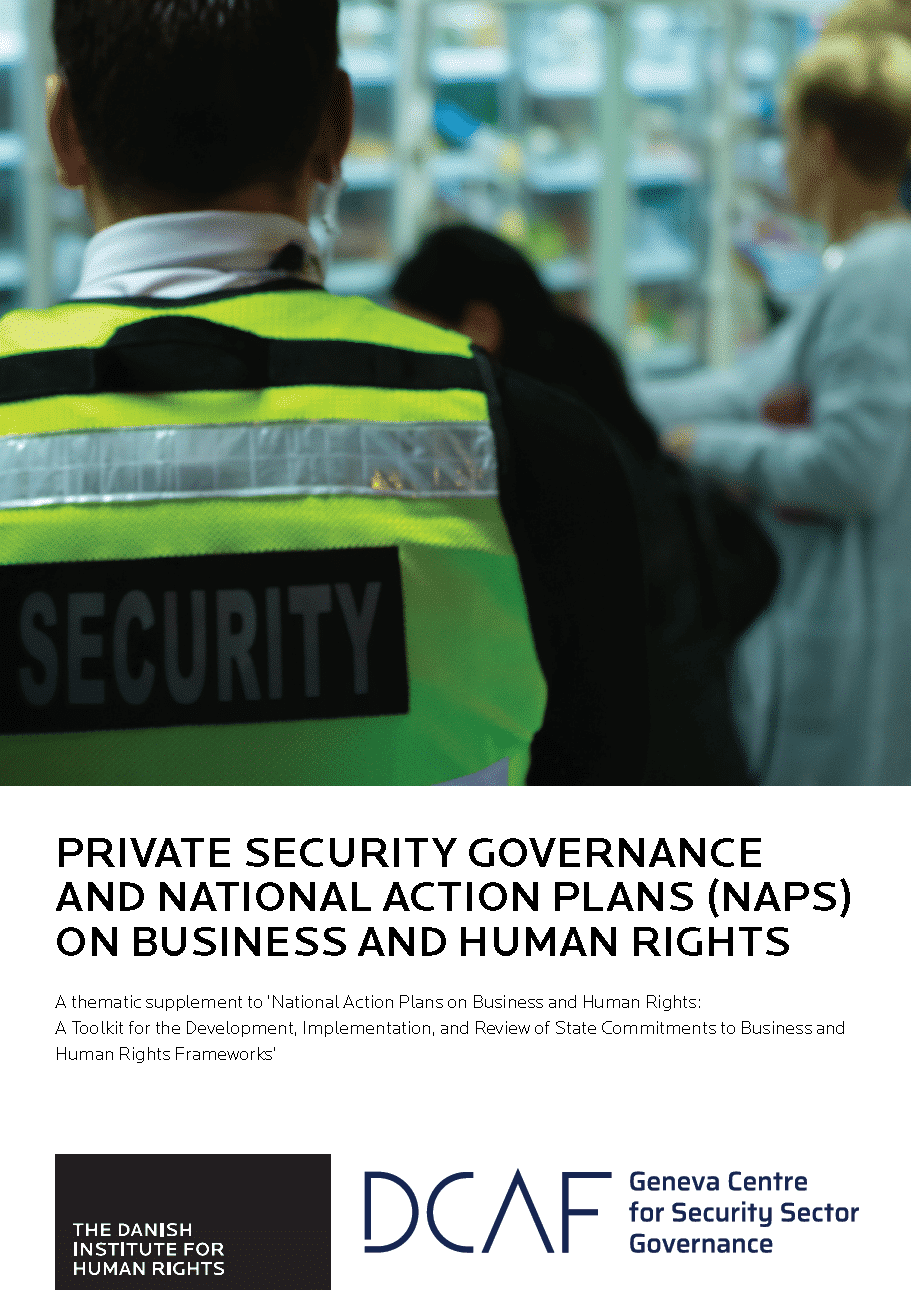
In November 2019, DCAF – Geneva Centre for Security Sector Governance and the Danish Institute for Human Rights published guidance on how to include private security governance within NAPs.
DCAF – Geneva Centre for Security Sector Governance also advocates for incorporating gender-based considerations into security sector reforms, noting that “[w]omen, men, girls and boys have different security experiences and priorities” and furthering that “[t]aking these differences into account when reforming the security sector strengthens the ability of security sector institutions to prevent and respond to violence related to gender roles and dynamics, such as domestic violence, sexual assault, human trafficking and anti-gay violence, and thus respond to the security needs of the public.” Likewise, the Organisation for Security and Co-Operation in Europe (OSCE) has released a Gender and Security Sector Reform Toolkit noting that since its initial publication in 2008, “tens of thousands of security and justice personnel globally have been trained on gender equality to some degree, scores of countries worldwide have adopted Women, Peace and Security national action plans, and new national legislation and international standards to tackle gender inequalities and discrimination have been passed.”
In February 2022, the Myanmar Centre for Responsible Business published a report on “Private Security Companies in Myanmar: A Baseline Study, Human Rights Risk Assessment and Recommendations”. The report provides a summary of the private security value chain and ecosystem, including the role played by regulation and by civil society stakeholders. In 2023, the International Code of Conduct for Private Security Service Providers’ Association published Investor ESG Guide on Private Security and Human Rights, to raise investor awareness about human rights risks and impacts connected to portfolio companies that procure the services of private security providers, and to provide support for investment firms to conduct appropriate human rights due diligence on their portfolio companies that procure the services of private security providers.
Another aspect of the private security industry and its relationship with human rights realisation is the analysis of the working conditions of employees. A 2023 study conducted by the International Code of Conduct for Private Security Service Providers’ Association, in partnership with UNI Global Union and the University of Denver, conducted research on the working conditions of private security personnel in a range of contexts. The study suggests that while “international community has developed key frameworks and mechanisms in an attempt to regulate this industry and mitigate human rights abuses, little attention has been paid to the working conditions of private security personnel themselves and the possible impact of working conditions on the likelihood of abuses and violations.” Through interviews and surveys, researchers identified that private security personnel face poor working conditions in terms of pay, working hours and health risks, labour migrants are commonly subjected to exploitative practices, and there is a direct link between working conditions and private security personnel’s respect for the law (See the Issue page on Workers’ rights for more information).
For the defence industry, PwC’s 2024 Annual Industry Performance and Outlook reports a 7% increase in overall revenues among the top 11 defence companies in 2023. The Financial Times reports that the leading 15 defence contractors are forecast to generate a free cash flow of $52 billion in 2026, almost doubling their combined cash flow at the end of 2021. The American Bar Association published “Defense Industry Human Rights Due Diligence Guidance” in 2022. The report suggests that defence exporters develop and implement a comprehensive human rights due diligence policy to address the human rights impacts of their products and services. A 2025 article underscores that obtaining regulatory approval does not relieve arms exporters of their ongoing responsibility to respect human rights, and that the mere possession of a valid license offers no immunity from potential civil or criminal liability arising from their activities (See the Issue page on Mandatory human rights due diligence for more information).
From a defence investment perspective, in 2025, the European Commission adopted the Defence Readiness Omnibus to mobilise up to EUR 800 billion in defence investments over the next four years. The accompanying Staff Working Document notes that, due to environmental and social concerns associated with the defence sector, many public and private financial institutions continue to exclude defence from their investment. A 2025 Financial Times article further observes that many investment funds have explicit prohibitions in their fund documentation preventing exposure to the defence sector, while fund managers are often reluctant to invest in companies involved in the manufacture of offensive weapons. On the other hand, the article introduces the concept of ‘ESSG’, environmental, social, security, and governance funds, highlighting some arguments that defence investments can be considered sustainable as they contribute to national security. Meanwhile, the UN highlights that the arms sector, which includes financial institutions and insurance companies that provide funding and/or financial loss protection to actors in the arms sector (including national governmental export credit agencies), should adopt stronger application of the UNGPs to prevent, mitigate, and remedy negative human rights impacts that this sector enables.
The 2030 Agenda for Sustainable Development and its Sustainable Development Goals (SDGs) relate to the topics of human rights and security through the SDGs on decent work (SDG 8) and peace, justice, and strong institutions (SDG 16). In order to take actions to contribute to advancement of these SDGs, companies can, for instance, provide adequate training for the management and the security personnel on how to respect human rights in both private and public domains, integrate a gender perspective in trainings, thereby promoting gender equality (SDGs 5.1 and 5.2), safe and secure working environment for all workers (SDG 8.8), and reducing the risk of violence (SDG 16.1), among others (See the Issue page on the 2030 Agenda for Sustainable Development for more information).
Working Group on the use of mercenaries as a means of violating human rights and impeding the exercise of the right of peoples to self-determination, UN Doc. A/77/268.
Strand 1: Training in the Field of Business and Human Rights
Action Point 1.2 (page 30)
The Under-Secretariat of Human Rights of the Ministry of Justice and Human Rights will: …
Promote the introduction of contents about business enterprises and human rights in training sessions held by the Armed Forces and the Order and Security Forces, when relevant, according to the trainees’ profiles.
i. Fundamental Pillar 1: The State’s obligation to protect human rights
(…)
Strand 3 [Eje nº 3]: Dissemination of the National Action Plan on Business and Human Rights and of instruments and strategies related to the promotion of these rights
(…)
The Ministry of National Defence will hold seminars and workshops for the security forces and companies to disseminate and raise awareness of the voluntary principles of security and human rights.
The Danish NAP does not make an explicit reference to the security sector. The provisions on conflict-affected areas refer to all businesses opearting in these environments.
II- Businesses’ Responsibility to Respect Human Rights
Introduction
Actions Underway [page 37]
France encourages businesses to adhere to the UN Global Compact or other voluntary initiatives such as ISO 26000 or the Voluntary Principles on Security and Human Rights, which help spread the UN Guiding Principles.
“The UN Guiding Principles attach particular priority to assisting enterprises in respecting human rights in areas torn by conflicts. One characteristic of such areas is an especially high risk of serious human rights violations resulting from the frequent total absence of state structures. The Federal Government therefore considers that it has a responsibility to try to ensure that German enterprises operating in such conditions have no part in any adverse impacts on human rights.”
Section 2: Current Legislative and Regulatory Framework
Supply Chain [page 15]
“The Government supports the proposal by the European Commission for an EU Council Regulation which provides for the establishment of an EU-wide system for supply chain due diligence of responsible importers of tin, tantalum and tungsten, their ores, and gold originating in conflict-affected and high-risk areas. The main objective of this proposal is to help reduce the financing of armed groups and security forces through mineral proceeds in conflict-affected and high-risk areas by supporting and further promoting responsible sourcing practices of EU companies. Of course, supply chain diligence is not limited to the extractive industries and areas of conflict.”
Section 3: Actions
I. Key commitments to ensure policy coherence across government [page 17]
“Ensure coherence between the implementation of the National Plan on Business and Human Rights and Ireland’s National Action Plan on Women, Peace and Security.”
‘Luxembourg’s NAP does not explicitly address this issue’
The 2020-22 NAP states the second edition of the National Action Plan complements the first NAP. Additional information about the first NAP can be found here.
The Nigeria NAP provides a list of existing constitutional obligations, domestic legislation, internation obligations, and police and administrative steps. This breakdown only looks at the list of challenges and the implementation of the 3 pillars of the UNGPs.
8.6 CHALLENGES … “o. Lack of involvement and inclusion of the community in the design and management of security architecture and operation of business that they host. p. Lack of human rights training for security providers in their logistic support and general oversight, including the Nigeria Security and Civil Defense Corps (NSCDC). q. Lack of inclusive security coverage for every entity in the business value Chain including business facilities, employees, suppliers, contractors, infrastructure and the community. r. Inability of Government to adequately monitor and ensure human rights are protected in the provision of security. s. Lack of partnership between businesses and public security.” (p.154-155)
PILLAR 1 – STATE DUTY TO PROTECT HUMAN RIGHTS ACTIONABLE ITEMS N. SECURITY “When businesses conduct risk assessment, the focus is mainly on the risk posed to their operation within the community without considering the risk their operations pose to communities. This makes them design their security apparatus without community input and consultation.
In addressing the issue of security and human rights in business operations, the Voluntary Principles on Security and Human Rights provides a useful guide. To this end; i. Government shall fulfill its obligation as the primary provider of security. ii. Communities will be involved in the design and management of company security. iii. Government shall provide human rights training for security providers, logistic support and general oversight. iv. Government shall monitor and ensure that human rights are protected in the provision of security. v. Security arrangement will be all inclusive and offer protection to business facilities as well as employees, suppliers, contractors and the community.” (p.160-161)
Strengthen guidance and dialogue with companies on human rights, business ethics, security and corruption in especially demanding markets.
…
2.6 Human Rights in Conflict Areas [page 26]:
There is an increasing demand from the business sector for dialogue and cooperation with the public authorities on security, risk assessment and corruption in conflict areas and demanding markets in these areas… Security personnel hired to protect Norwegian interests, whether private or public, pose a potential problem. States that hire private security guards must ensure that these comply with the state’s obligation to protect against human rights violations. The Voluntary Principles on Security and Human Rights and the International Code of Conduct for Private Security Service Providers are useful guidelines for private business enterprises on how best to ensure their security.
Although there are no binding international instruments that support State obligations in the area of private security and human rights, a series of soft law standards have been identified: the Montreaux Document, the International Code of Conduct for Private Security Providers, and the Voluntary Principles on Security and Human Rights. For its part, the State has incorporated specific national norms for the regulation and oversight of the sector’s services. The creation of Sucamec (The National Superintendence for the Control of Security Services, Arms, Ammunition, and Explosives for Civilian Use), the regulatory authority for the sector and attached to Minister (Ministry of the Interior), represents a step forward, and it is essential to strengthen the capacity of this entity to produce standards, manuals, guidelines, among others.
For their part, most private security providers have not yet adopted explicit commitments on human rights. In addition, there is insufficient public information on the due diligence processes that private security companies follow to carry out their operations. In terms of reparation mechanisms, the judicial system presents pre-existing barriers that affect access to justice, especially for the most vulnerable people, and therefore, access to judicial reparations. – page 51
Table 8: NAP strategic guidelines and objectives, and alignment with the axes of the Peru Vision 2050
Strategic guideline No. 2: Design of public protection policies to prevent human rights violations in the business environment.
Objective No. 1: Promote regulatory actions to prevent human rights violations in the corporate sphere
28.
Action: Prepare an analysis report on the application of standards for the use of force in the provision of extraordinary police services, which in turn should be extended to companies that provide and contract private security.
Background: Although some private security companies have been adopting human rights policies, private security providers (PSPs) lack provisions regulating the use of force in the scope of their activities. There are also no provisions that determine the role of the companies and/or individuals that contract private security services. A report will be prepared with the purpose of analyzing the application of standards for the use of force within the framework of the provision of extraordinary police services, which in turn will be extended to companies that provide and contract private security. This report will serve as a basis for the formulation of provisions or guidelines on the matter.
Authorisation to export arms and military equipment
[page 30-31]
“The Security Policy Department of the Ministry of Foreign Affairs will take into account the United Nations Guiding Principles on Business and Human Rights in the course of assessment procedure regarding applications for granting permission to export arms and military equipment, in accordance with Articles 12 and 12 a. of the Act of 29 November 2000 on Foreign Trade in Goods, Technologies and Services of Strategic Significance for State Security and for Maintaining International Peace and 31 Security and Article 88 of the Act of 13 June 2019 on Conditions of Business Activity related to the Production of and Trade in Explosives, Weapons and Ammunition, as well as Products and Technologies to be used for Military or Police Purposes. A criterion taken into account by the Department when assessing applications for the granting of export licences is, inter alia, a risk assessment as to whether the arms to be exported could be used for activities in violation of international humanitarian law or whether the granting of the licence would have a negative impact on respect for human rights.”
Promotion of the Montreux Document on Private Military and Security Companies and the International Code of Conduct for Private and Military Security Companies
[page 31]
“The Ministry of Foreign Affairs plans to undertake activities aimed at promoting among entities contracted to protect Polish diplomatic missions the knowledge and application of both the International Code of Conduct for Private and Military Security Companies and the principles laid down therein, as well as the Montreux Document on Private Military and Security Companies, an intergovernmental document aimed at promoting respect for international humanitarian law and human rights by private military and security companies, especially when they are present in armed conflicts”’
Principle 6 – Commercial transactions between states and businesses
Two sets of guidelines are in preparation in cooperation with professional interest groups, namely: Guidelines on the public procurement of security services
“The Government will examine how to apply criteria aligned with the Guiding Principles in relation to Royal Legislative Decree 3/2011, of November 14, which approves the revised text of the Public Sector Contracts Law, the Law 16 24/2011 , of 1 August, of contracts of the public sector in the fields of defense and security, and other regulations in force in the same field”
Guiding Principle 7
Measure 2
“Within the framework of the implementation of the II National Action Plan on Women, Peace and Security, the Government will develop tools and action guides directed to companies on how to address the risk of sexual violence and gender violence in conflict situations.”
Measure 3
“The Government undertakes to include clauses on respect for human rights when contracting private military and security services in accordance with the United Nations Basic Principles on the Use of Force and Firearms by Law Enforcement Official Officials (1990), the Code of Conduct for Law Enforcement Officials (1979) and the Arms Trade Treaty (2013).”
The Swedish NAP does not make an explicit reference to security sector, apart from provisions concerning operations in the conflict zone that refer generally to all companies operating there.
2.2 Updating the measures contained in the NAP 2020–2023
Measure 5: Multi-stakeholder initiatives on business and human rights
…Switzerland plays an active role in supporting various multi-stakeholder initiatives, including the cocoa, gold, textiles and coffee sectors, and in implementing the Voluntary Principles on Security and Human Rights and the International Code of Conduct for Private Security Service Providers. These efforts, which supplement the new legislative measures, seek to maximise the positive impact of companies on the ground while promoting social and environmental sustainability.
The 2024-27 National Action Plan is supplemental to the 2020-23 NAP. The 2020-2023 NAP explicitly addresses this issue.
Additional Information about the 2020-23 NAP can be found here.
The UK 2016 NAP refers to security sector in the section devoted to Actions Taken [page 9]:
“To give effect to the UN Guiding Principles, the Government has: (…) in March 2015 the Government concluded its chairmanship of the Voluntary Principles Initiative. During our chairmanship we worked to raise awareness of the VPI in priority countries for membership, to support UK oil, gas and mining companies to use the VPs to manage security and human rights risks more effectively, and encouraged greater openness by companies in line with the UN Guiding Principles on Business and Human Rights. More detail on our chairmanship year can be found in our 2014 annual report.”
The UK 2016 NAP states, in the section discussing Government Commitments, that [page 10]:
“The Government will do the following to reinforce its implementation of its commitments under Pillar 1 of the UNGPs: (…) Continue to work closely with Voluntary Principles on Security and Human Rights Initiative (VPI) member governments, extractive companies and civil society organisations, to promote greater understanding of the Voluntary Principles and strengthen the implementation, effectiveness and membership. To maintain the momentum from our chairmanship March 2014-March 2015, we will continue to work on better corporate implementation of the Voluntary Principles on the ground. This includes maintaining dialogues with ‘host’ governments. For example, we have worked with the Government of Angola to promote the Voluntary Principles to the participating governments of the Kimberley Process Certification Scheme.”
The UK 2016 NAP states in the section regarding The Nairobi Process: a Pact for Responsible Business, that [page 12]:
“Kenya has recently granted 47 oil and gas exploration licences. This has raised expectations of economic benefits by government, business and local communities. Experience elsewhere in Africa suggests that if the licences are not managed carefully then competing expectations of these actors can lead to community tensions and security risks. The Human Rights and Democracy Programme (2013/14) funded the Nairobi Process: A Pact for Responsible Business – an initiative developed by the Institute for Human Rights and Business (IHRB) in collaboration with the Kenya National Commission on Human Rights (KNCHR). It aims to embed the UN Guiding Principles on Business and Human Rights in the extractives sector in Kenya. It focused on several strands of engagement, including bringing together multinational and national extractive companies, government and civil society and communities to collaboratively address key areas of human rights concern. It also supports business to business learning, capacity building for National Human Rights Institutions in the region and advocates for the implementation of the UNGPs by the government of Kenya.”
The UK 2016 NAP highlights security in the section: EHCR Projects – practical guidance for care/security sectors and Boards Directors\reporting [page 17]:
“The Commission is working in partnership with the Financial Reporting Council and Shift to publish guidance early in 2016 to help company boards to understand what they are expected to know, do and say about human rights. It will provide company boards with smart questions to ask of the business, help them to understand how human rights risks align with business risk, and bring clarity and coherence to different human rights reporting requirements. The Commission is working with the Institute of Human Rights and Business to publish guidance in early 2016 for UK businesses in the care and private security sectors. The guidance will include an assessment of the main human rights impacts in each sector and practical guidance for managers in areas such as human resources, operational delivery and procurement.”
The UK 2016 NAPin theGovernment Commitments section mentions security [page 16]:
“The Government will continue to encourage UK companies in their work to respect human rights. We will: (…) provide support to Board Directors on human rights reporting and practical guidance for companies in the care and security sectors in the UK, through Equality and Human Rights Commission funded projects.”
Section III: Additional National Action Plan Commitments …
Table 1: Expanding Engagement and Coordination on Responsible Business Conduct Commitments
The Department of State will “leverage its Chairship (Chair through May 2025) of the Voluntary Principles on Security and Human Rights Initiative (VPI) to make meaningful governance reforms and expand membership of the Initiative to include other land-intensive industries. The VPI is a multistakeholder initiative that provides guidance to companies on providing security for their operations in a manner that respects human rights.” (p.17)
Table 2: Procurement Commitments
“The U.S. Department of Defense (DoD) will conduct a review to evaluate the value of encouraging or requiring membership in the International Code of Conduct Association for Private Security Providers’ Association for its private security company (PSC) vendors as part of its commitment to continuously reviewing, updating, and strengthening its policy and oversight for contracted private security functions. While DoD already has a third-party certification requirement in place for its private security contractors, ongoing evaluation and review of options will ensure DoD continues to uphold its commitment to strengthening PSC oversight structures and incentivizing PSCs to engage in RBC.” (p.18)

 Individuals working for PMSCs have engaged in several human rights abuses, including torture of detainees, shootings and killings of innocent civilians, destruction of property, sexual harassment and rape, human trafficking in the recruitment of third-country nationals, weapons proliferation, and participation in renditions For example, in 2015, a former Blackwater Worldwide security guard was found guilty of killing 14 unarmed Iraqi civilians in 2007 and sentenced to life in prison (See the Issue page on Privatisation for more information). Security contractors hired by the world’s largest gold-mining company, Barrick Gold Corporation and its subsidiary, African Barrick Gold, have been accused of raping, gang-raping and killing in Porgera, Papua New Guinea, and in North Mara, Tanzania, respectively. In 2011, a UK-based mining company, Monterrico Metals, reached an out-of-court settlement with 33 peasant farmers who alleged that the company’s hired security guards colluded in human rights violations against them, which included torture during protests at the Rio Blanco project in 2005. Transparency International raises concerns over the heightened global risks of fraud, corruption and violence in PMSCs’ activities around the world.
 Belgium (2017 - open)
 Chile (2017-2020)
 Colombia (2020-2022)
 Czechia (2017-2022)
 Denmark (2014-open)
 Finland (2014-2016)
 France (2017-open)
 Georgia (2018-2020)
 Germany (2016-2020)
 Ghana (2025 - 2029)
 Indonesia (2023-2025)
 Ireland (2017-2020)
 Italy (2021-2026)
 Japan (2020-2025)
 Kenya (2020-2025)

 Liberia (2024 - 2028)
 Lithuania (2015-open)
 Luxembourg (2020-2022)
 Malaysia (2025-2030)
 Mongolia (2023-2027)

 Netherlands (2022-2026)
 Nigeria (2024-2028)
 Norway (2015-open)
 Pakistan (2021-2026)
 Peru (2021-2025)
 Poland (2021-2024)
 Slovenia (2018-open)
 South Korea (2018-2022)
 Spain (2017-2020)
 Sweden (2017-open)
 Switzerland (2024-2027)

 Thailand (2019-2022)
 Uganda (2021-2026)
 United Kingdom (2016-open)
 United States (2024 - open)

